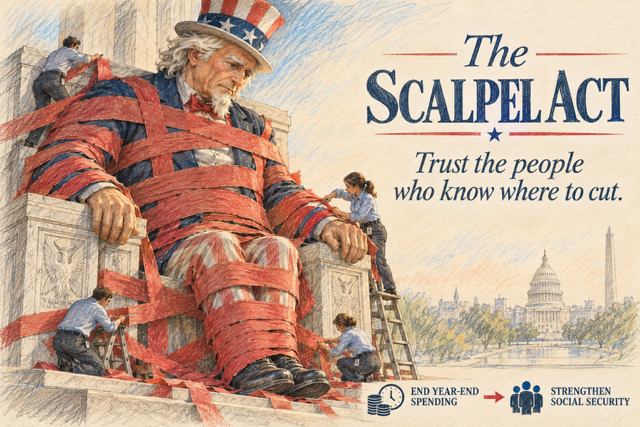
THE SCALPEL ACT
Listen to the people who do the work. Then give them the power to fix what they already know is broken.
For decades, Washington has approached government efficiency from the top down. Political leaders announce cuts, commissions study agencies, consultants write reports, new management rules are imposed, and federal employees are told to produce more documentation showing that the latest reform is working.
The Scalpel Act begins somewhere very different.
It begins with the people inside the federal government who actually manage the money, buy the equipment, negotiate the contracts, administer the grants, inspect the food, guide the airplanes, protect critical infrastructure and deliver the services Congress funds.
Chief Financial Officers, budget officers, managers and career employees consulted in developing Scalpel were asked a practical question: Where is the money really being wasted, and what would you change if Washington gave you the authority to fix it?
Their answers point to a government filled with incentives that produce exactly the behavior taxpayers dislike. Managers are rewarded for spending budgets down. Hundreds of billions flow through a shadow workforce of service contractors performing permanent government jobs. Federal purchasing rules have become so complicated that competition suffers. Decades of accountability laws have created parallel reporting systems consuming extraordinary amounts of employee and contractor time. Government watchdogs repeatedly identify savings opportunities that sit waiting for action. Other federal policies impose costs on families in one place and then require taxpayers to pay again somewhere else.
The people who helped build Scalpel believe those problems contain far more than $1 trillion in potential savings. They chose $1 trillion over three years because they wanted a target federal employees could realistically achieve rather than a theoretical total built by adding every possible saving together.
The target is therefore a starting point for performance. Employees who find more should return more. Agencies that outperform the target should be celebrated for doing it.
Scalpel reaches that goal through six major reforms.
1. REWARD SAVING, RATHER THAN SPENDING
The pool: roughly $1.8 trillion every year
The first opportunity sits inside approximately $1.8 trillion in annual discretionary federal funding. The Scalpel target is straightforward: federal employees should be able to perform the mission while returning an average of 10 percent each year. At the current scale, that represents approximately $180 billion annually and $540 billion over three years. The underlying draft uses the same roughly $1.8 trillion annual discretionary base.
The problem begins with the way budget execution affects federal managers. Employees responsible for public money can face performance expectations tied to spending the appropriation they received. That creates an extraordinary conflict: the person taxpayers expect to question an unnecessary expenditure can also have a professional incentive to make sure the money gets obligated before the fiscal year closes.
The results become visible every September. Economists Jeffrey Liebman and Neale Mahoney studied millions of federal procurement transactions and found that spending during the final week of the fiscal year reached approximately 4.9 times the normal weekly rate. They also found significantly poorer outcomes among year-end information-technology projects.
Scalpel changes the incentive where it begins: in the employee’s performance expectations.
Federal officials responsible for money become responsible for identifying savings as part of successful management. Agencies receive their full appropriations, employees perform the work Congress funded, and managers spend what the mission requires. Money remaining in the account when the fiscal year closes represents money the taxpayer supplied and the agency successfully avoided spending.
Those year-end savings are directed to Social Security.
The agency then receives full funding again in the following fiscal year. That feature changes the psychology of federal budgeting. A manager can pursue savings aggressively because a successful year of thrift becomes an achievement rather than a reason for the organization to fear its next appropriation.
The effect can spread quickly. An office completing its mission for 93 percent of its funding returns seven percent. Another office redesigns its purchasing and returns 11 percent. A third agency finds enough unnecessary spending to return 15 percent. Managers begin exchanging ideas about how to produce better results for less money because savings have become a measure of strong management.
The target across government is 10 percent every year. At roughly $1.8 trillion annually, that creates a path to approximately $540 billion in three-year savings from this reform alone.
Scalpel turns September from a spending race into a savings race and gives federal employees a direct reason to ask the question every taxpayer wants asked: Do we actually need to spend this dollar to accomplish the mission?
2. END THE SHADOW WORKFORCE
The pool: approximately $487 billion every year in federal service contracts
Federal agencies spend approximately $487 billion each year on service contracts. The CFOs, budget staff and managers consulted in writing Scalpel were emphatic about what sits inside that figure: in their experience, roughly 90 percent of service-contract positions function as shadow federal staff.
These are continuing positions. The worker appears every day, performs an ongoing government function, supports the same agency program and returns under another contract period or renewal. The government expects the work to exist next year and the year after that. The service contractor has effectively become a corporate payroll system sitting between a permanent worker and the federal government.
Scalpel ends that structure.
At a 90-percent transition objective, approximately $438 billion of the current $487 billion annual service-contract pool ultimately moves from corporate service contracts toward direct federal employment.
The potential savings are enormous because contractor billing rates can substantially exceed federal compensation. The Project On Government Oversight examined 35 occupations and found government-approved contractor billing rates averaging 1.83 times the total compensation of comparable federal employees, including federal benefits. Federal employees were less expensive in 33 of the 35 occupations examined.
POGO’s subsequent examination of Department of Defense data found an even larger gap, estimating contractor employees at 2.94 times the cost of comparable DoD civilian employees.
The government-wide 1.83 ratio provides a useful conservative way to understand the scale. Work costing taxpayers $183 through a service contractor corresponds to approximately $100 in total federal employee compensation. That implies a savings opportunity of roughly 45 percent of the contractor cost when the corporate layer disappears.
Applied to approximately $438 billion of service-contract spending, that produces a mature savings opportunity approaching $199 billion every year.
The mechanism is intentionally direct. CFOs, budget officers and responsible managers authorize federal vacancy announcements for continuing service-contract positions. Funding moves with the work. As the service contract reaches its end, the position moves onto the federal payroll and the corporate contract covering that staff position disappears. The supporting Scalpel material describes this transition directly: bring the job home, move the funding, and allow the service contract to run out.
The contractor employee already performing the work can compete for the federal position. That preserves the worker’s expertise, security knowledge, program experience and institutional memory while removing the layer of corporate overhead and profit surrounding the job.
The economics extend beyond contractor profit. Every service contract also requires a federal contracting apparatus: solicitation, contract administration, invoice review, contracting officers’ representatives, renewals, modifications and recompetes. The supporting research identifies more than 52,000 certified contracting officer representatives at civilian agencies alone and describes an additional contract-management cost layered on top of the contractor billing rate.
The political dimension matters because the companies benefiting from this structure are sophisticated participants in Washington. Large federal service contractors maintain lobbying operations, trade associations and political programs. That gives the shadow-workforce system an organized constituency with a strong interest in preserving federal contract revenue.
The employees consulted in developing Scalpel therefore see the 90-percent objective as central to the reform. A small conversion program would preserve hundreds of billions of dollars in corporate intermediation while leaving the basic shadow-workforce structure intact.
The Scalpel principle is direct: when the government needs the job year after year, make it a government job. Keep the worker where possible, end the service contract, and keep the savings for the taxpayer.
At full scale, this reform alone carries a potential annual savings capacity approaching $199 billion using the government-wide POGO cost relationship.
3. BUY LIKE THE WORLD’S LARGEST CUSTOMER
The pool: approximately $793 billion every year
The federal government committed approximately $793 billion through contracts in fiscal year 2025. At that scale, every percentage point of improvement in federal purchasing is worth almost $8 billion a year.
Scalpel sets a purchasing-efficiency target of 5 percent, representing approximately $40 billion annually and $120 billion over three years at the current purchasing level.
The opportunity comes from restoring competition.
Federal procurement accumulated layer after layer of rules intended to protect taxpayers, standardize purchasing and prevent abuse. Over time, that regulatory structure became a substantial barrier of its own. The current Scalpel research describes thousands of acquisition directives layered with individual agency requirements, creating transaction costs for companies seeking to sell to the federal government.
Complexity matters because government gets its best prices when capable companies want to compete for its business. A procurement system that requires specialized expertise merely to understand how to bid naturally favors incumbents and discourages new entrants.
Scalpel replaces that accumulation with a concise Federal Purchasing Code centered on six principles: competition, reasonable pricing, performance, transparency, integrity and access.
Federal buyers should be able to establish that a purchase was genuinely competed, that the government paid a defensible price, that supplier performance matters, that the transaction is visible to taxpayers, that fraud and conflicts are controlled, and that new suppliers can understand how to participate.
The Act also creates consequences for weak competition. Agencies whose contracting consistently produces sole-source awards or single bids must identify the causes and develop plans to expand the supplier base. Market research becomes part of restoring competition before the solicitation is issued.
The people performing substantive purchasing work remain critical. Contracting officers, pricing specialists, market researchers and oversight staff create savings when they have the authority and time to negotiate well. Scalpel directs reform toward the accumulated rules and approval structures surrounding those professionals rather than toward the purchasing capability itself.
The five-percent target is deliberately achievable. Strategic procurement research cited in the supporting material has found substantially larger savings opportunities in sophisticated purchasing organizations, while federal category-management initiatives have already produced significant reported savings.
On a $793 billion annual base, a five-percent improvement yields roughly $40 billion a year and approximately $120 billion over three years. Better competition could produce considerably more.
4. END THE GOVERNMENT’S PARALLEL REPORTING ECONOMY
The pool: hundreds of billions in federal and federally funded administrative activity
This is one of the largest and least visible opportunities in Scalpel.
Federal reporting grew through accumulation. Congress and successive administrations created one accountability structure after another, each aimed at improving transparency or performance. The result today is a dense network of strategic plans, performance plans, audited financial statements, grant-compliance audits, award reporting, subaward reporting, quarterly reviews, transaction-level databases, evidence plans, learning agendas, data offices, evaluation offices, statistical offices and thousands of individual performance measures.
Each requirement created machinery around it.
Program offices collect the information. CFO organizations code and reconcile it. Grants offices transmit requirements to recipients. Performance offices assemble the results. Auditors test the systems. Contractors build the software. Consultants prepare agencies for reviews. Universities, hospitals, school systems, nonprofits and state agencies create their own compliance staffs because federal reporting requirements travel with the federal money.
The result is what the Scalpel analysis describes as parallel operating systems sitting beside the programs taxpayers intended to fund.
The scale is easier to understand by following one federal performance measure. A person receiving a federally supported service can generate information that appears in program reporting, strategic planning, financial reporting, grant compliance, subaward reporting, transaction systems, quarterly performance reviews and evidence requirements. Each system can require different coding, validation, audit trails, certifications and personnel.
Then multiply that process across tens of thousands of performance measures, every cabinet department, thousands of grant programs, millions of transactions, universities, hospitals, school districts, nonprofits, contractors, state governments and local governments.
The reporting structure becomes an economy of its own.
Congress created much of that accumulation. The Government Performance and Results Act, financial-management reforms, the Single Audit framework, federal funding transparency requirements, GPRA modernization, the DATA Act, the Evidence Act and Uniform Guidance each added a new accountability architecture. Earlier requirements remained in operation as newer systems arrived.
Federal employees therefore spend enormous amounts of time satisfying several generations of accountability rules simultaneously. A single underlying activity can appear in several different reporting frameworks, each built around the vocabulary and data architecture of the era that created it.
The burden then moves outside government.
Federally funded universities and research institutions provide one of the clearest examples. Faculty workload studies by the Federal Demonstration Partnership have repeatedly found that researchers devote a striking share of federally funded research time to administrative requirements associated with their awards. The supporting Scalpel research places that burden around 42 to 44 percent of research time in major surveys.
That represents something much larger than the price of writing an annual report. It represents scientists hired to conduct research spending major portions of their funded time on administration, clinicians recording data for multiple federal systems, nonprofit employees serving reporting requirements alongside clients, state employees reconciling federal categories, and federal workers maintaining the systems that receive all of it.
The supporting analysis estimates the combined reporting and compliance economy in the hundreds of billions of dollars annually once the federal apparatus and the burden pushed onto organizations receiving federal money are considered together. A precise government-wide total still requires independent scoring, because the costs are distributed among payroll accounts, contracts, grants, software systems, audit costs and employee time rather than appearing in one federal ledger.
Scalpel attacks the architecture rather than trimming individual reports.
The accountability standard becomes simple: What is the agency legally required to do? How much did it spend? What did it deliver?
Agencies use operational information they already collect. Congress and the public receive a concise accountability statement. The offices, contractors, systems and downstream reporting requirements created solely to feed duplicative reporting structures can then disappear with the requirements that created them.
This reform returns something equally valuable to cash: time. A scientist gets research hours back. A clinician gets patient time back. A grant manager gets program time back. A federal employee gets mission time back. The taxpayer receives more of the work the appropriation was supposed to purchase.
Scalpel therefore treats reporting reform as a major savings engine. The objective is to collapse overlapping accountability systems into one intelligible structure and release hundreds of billions of dollars and millions of working hours currently absorbed by the parallel reporting economy.
The standard is simple: measure the result once, report it clearly, and put everyone else back to work.
5. ACT ON THE WASTE THE GOVERNMENT HAS ALREADY FOUND
The pool: at least another $100 billion in identified opportunity
Federal taxpayers already finance a vast oversight infrastructure. GAO, Inspectors General, auditors and financial-management staffs spend years identifying duplication, fragmentation, weak controls and savings opportunities.
Scalpel turns those findings into an action agenda.
GAO’s 2026 duplication and cost-savings work reports that congressional and agency action on recommendations made since 2011 has already produced approximately $774.3 billion in financial benefits. GAO still has 610 open matters and recommendations, and estimates that completing the remaining work could produce another $100 billion or more in financial benefits.
A broader GAO analysis published in 2026 estimated the potential financial benefit associated with its open recommendations and congressional matters at approximately $132 billion to $251 billion.
Scalpel uses that work rather than commissioning another search for waste.
Agency leaders and budget staffs receive a ready-made inventory of recommendations generated by professional auditors and analysts. Those recommendations become part of the management agenda alongside the savings targets established elsewhere in the Act.
The same philosophy applies to audits. Financial oversight should concentrate resources where risk is greatest. Agencies with material weaknesses, serious improper-payment problems, poor audit results or high-risk programs receive the strongest scrutiny. Organizations with stable controls use a longer financial-statement audit cycle while maintaining their financial statements and internal-control responsibilities.
That directs more audit capacity toward fraud, improper payments and weak controls.
Scalpel also addresses a quieter administrative industry: government billing government. Federal agencies maintain countless reimbursable agreements under which one agency charges another agency for services. Those arrangements require agreements, invoices, accounting systems, collections, reconciliations, disputes and audits.
The federal government currently lacks a comprehensive measure of what this internal billing apparatus costs. Scalpel directs OMB and Treasury to inventory the agreements, people and systems supporting them, then simplify arrangements whose administrative cost overwhelms their management value.
This entire section reflects one of Scalpel’s governing ideas: the government has already paid to find a great deal of its waste. The next return comes from acting on what its own experts found.
6. END THE SUGAR DOUBLE BILL
The pool: billions in annual consumer costs plus major public water-management expenditures
Florida provides a powerful example of another Scalpel principle: government should look at the full economic cost of a policy rather than the single budget account where that policy appears.
Federal sugar policy maintains domestic sugar prices through supply controls, marketing allotments and import restrictions. GAO’s review of the program found that higher sugar prices cost sugar users and consumers approximately $2.5 billion to $3.5 billion every year, while the overall economic loss after producer benefits is roughly $1 billion annually.
Those higher costs flow through grocery stores, food manufacturing, restaurants and every business that purchases sugar as an input.
Florida taxpayers simultaneously finance enormous water-management and environmental-restoration efforts connected to the broader South Florida system. Agriculture, nutrient loading, Lake Okeechobee management, the Everglades and coastal estuaries form parts of the same environmental and economic landscape.
Scalpel brings those costs onto one ledger.
The purpose is to ask what families pay through federal sugar policy, what taxpayers spend managing the surrounding water system, and how changing the underlying incentives can reduce both.
That is the same analytical discipline applied throughout the Act. A government rule can impose a cost outside the agency administering it. Scalpel follows the cost wherever it appears.
The sugar reform therefore gives Florida families a clear example of what the broader legislation means in practice: look at the whole system, identify where government policy is making people pay more than once, and fix the rule creating the double bill.
WHY $1 TRILLION IS A SERIOUS THREE-YEAR TARGET
The scale of the six reforms makes the trillion-dollar goal easier to understand.
The first reform reaches into roughly $1.8 trillion in annual discretionary funding. A ten-percent annual savings target produces approximately $180 billion each year, or about $540 billion over three years.
Federal purchasing represents another $793 billion each year. A five-percent improvement produces approximately $40 billion annually, or around $120 billion over three years.
Federal service contracting represents approximately $487 billion annually. The CFOs, budget staffs and managers consulted in developing Scalpel believe roughly 90 percent functions as a continuing shadow workforce, putting approximately $438 billion a year into the eventual conversion pool. Applying POGO’s government-wide contractor cost ratio produces a mature savings opportunity approaching $199 billion every year.
Those three reforms alone demonstrate the size of the field.
The first two targets represent approximately $660 billion over three years before the shadow-workforce transition is fully counted. Contractor conversion then grows toward an annual savings capacity approaching $200 billion. The reporting economy represents another very large pool of administrative cost and productive time. GAO identifies at least another $100 billion in open opportunities, with its broader 2026 analysis placing measurable future benefits from open recommendations and congressional matters substantially higher. Sugar and internal government billing create additional savings opportunities.
Scalpel deliberately avoids adding every maximum estimate together and presenting the result as a promise.
The people who developed the plan looked at a much larger universe of potential savings and selected $1 trillion over three years as a target federal employees believe they can reach.
That distinction matters.
A campaign number built by stacking every theoretical saving produces a headline. A performance target built by people who understand the system creates something managers can actually pursue.
Under Scalpel, the federal workforce receives a clear assignment: find $1 trillion in three years and beat the target whenever you can.
LEAD BY LISTENING FIRST
The philosophy behind Scalpel reaches beyond the arithmetic.
Government reform works best when leadership understands that the people closest to a system often know its failures better than anyone else. Federal employees live inside the spending rules, contractor relationships, reporting systems and procurement requirements every day.
They know which September purchases are driven by the calendar.
They know which contractor positions have become permanent federal jobs in everything but name.
They know which acquisition rules keep capable companies from bidding.
They know which reports consume hundreds of hours and change zero decisions.
They know which audit findings and GAO recommendations have sat unanswered.
The Scalpel Act gives those employees a reason and an avenue to act on that knowledge.
This matters because federal employees perform work Americans encounter every day. They guide aircraft, inspect food, protect critical infrastructure, manage public money, conduct scientific research, maintain national-security systems and deliver services on which millions of people depend.
Strong organizations get better by making capable employees part of the solution.
Scalpel therefore approaches federal employees as operating experts. Leadership sets the mission and the target. Employees closest to the work find the savings. Agencies compete to return money. Successful managers build reputations for doing more with less. Taxpayers can see the result.
The transformation is cultural as much as financial.
September can become the month agencies celebrate how much they returned.
CFOs can take pride in shrinking their shadow workforce.
Contracting offices can compete to attract more bidders.
Scientists and clinicians can spend more hours performing the work taxpayers funded.
Agency leaders can close GAO recommendations rather than adding them to another backlog.
And the savings produced by disciplined year-end management can flow directly into Social Security.
That creates a simple connection between better government and something Americans understand immediately: money that government employees successfully avoid spending can strengthen a program workers paid into throughout their careers.
THE SCALPEL STANDARD
Scalpel asks government to operate according to the same basic standard taxpayers apply everywhere else: accomplish the mission, understand the full cost, remove the unnecessary layers, and spend less whenever better management makes that possible.
The Act rewards employees for returning year-end money. It ends the shadow workforce performing permanent federal jobs through corporate service contracts. It rebuilds purchasing around competition. It dismantles the parallel reporting economy. It acts on savings the government’s own watchdogs already identified. It examines policies that make families and taxpayers pay the same bill in multiple places.
Together, those reforms create an opportunity much larger than the target itself.
$1 trillion in three years is the assignment. Success can be bigger.
The people who do the work believe the savings are there. The Scalpel Act gives them the authority, the incentives and the mandate to go find them.
Listen to the people who do the work. Give them the power to fix what they know is broken. Save the money. Strengthen Social Security.
Principal sources
The research supporting the Scalpel Act includes the Government Accountability Office’s FY2025 government-wide contracting data, which reports approximately $793 billion in federal contract commitments; GAO’s 2026 duplication and cost-savings work, documenting approximately $774.3 billion in benefits already achieved and at least $100 billion more available through open recommendations; Project On Government Oversight research finding average contractor billing rates of 1.83 times federal employee compensation; Liebman and Mahoney’s research on federal year-end spending; GAO’s analysis of the federal sugar program; and the federal reporting and compliance research assembled in the Scalpel supporting papers.
The supporting Scalpel materials also document the service-contract structure and implementation concept, the scale and mechanics of federal performance-reporting requirements, and the way decades of accountability statutes have created overlapping systems throughout agencies and organizations receiving federal funds.
Retired Civil Servants Expose the #MiddlemanClass
THE MIDDLEMAN CLASS (of Billionaires)
They promised to end waste, fraud and abuse in Washington. They didn't. They made it worse.
They moved it where you can't see it.
Government Reform has been nothing but a shell game. A rigged one. And you keep losing.
Retired civil servants like me have watched it for years. Politicians brag about record savings. Then the budget goes UP. Every time. Every single time.
They cut the cheapest, most basic work the government does. They brag. Then they pour more money than ever into the most bloated part. Again. And again. And again.
Last year Washington cut the inspectors who check the chicken, beef and eggs in your fridge. Complaints about bad meat, poultry and eggs? Up 40 percent. The highest ever recorded. Ever.
That same year, Washington spent $808 billion on contractors. A record. Fewer inspectors. More contractors. Worse food.
Contractors cost MORE. A lot more. The watchdog group POGO compared 35 jobs. Same work. Same job. The contractor cost 83 percent more than a federal employee. Nearly double. The federal worker was cheaper in 33 of 35 jobs. In one job, the contractor cost almost FIVE times as much.
Five times.
So they fire the worker. Then they buy the same work back from a contractor at nearly double the price. And they call it savings. That's the trick. They want you to watch one hand: the federal payroll. DOGE cut more than 350,000 federal workers and threw a party. Smaller government!
Wrong.
Watch the other hand. Contract spending hit an all-time record. Contract workers already outnumber civil servants more than two to one. And how many are we paying for now? Nobody knows. Washington doesn't even count them. Not one official number. The government didn't shrink. It moved off the books, where it costs you nearly double.
Did you pick up what we just told you? The federal work force they tell you about cutting is far less than half of the entire federal workforce, and they never mention the more expensive side to you, when they wield a chainsaw. They grow that side, and brag to you about savings from the small side.
So why would anyone pay a middleman so much? Follow the money.
An inspector's paycheck goes home to a family. An inspector doesn't hire lobbyists. An inspector doesn't write campaign checks.
A contractor does.
So they fire the worker. Then they buy a contract. The contractor takes its profit, sends a piece back to Washington in lobbyists and campaign checks, and they call it savings.
Savings!
That's the trick. They want you to watch one hand: the federal payroll. DOGE cut more than 350,000 federal workers and threw a party. Smaller government!
Meet the middlemen. Leidos. You've probably never heard of it. You pay for it anyway. 87 percent of its money comes from the government. Last year it pulled in $17.2 billion. Its own executives called 2025, the year of DOGE firings, an outstanding year.
Outstanding. For them.
Booz Allen Hamilton. 98 percent of its money comes from the government. It doesn't build tanks. It doesn't build planes. It sells people. The same work civil servants do, at nearly double the price.
They don't make anything. They stand in the middle and take a cut. That's the middleman class.
Everybody knows about the September spending spree. Everybody. Every year Washington races to burn its money before September 30. Last September the Pentagon spent $93 billion in one month. A record. More than half of it in the last five working days. Almost $7 million on lobster.
Lobster.
That was the easiest fix in Washington. A child could find it. DOGE didn't touch it.
Why not? Because DOGE was busy. Busy cutting the people who work for you. Busy growing the middleman class. And busy protecting its boss. Elon Musk ran DOGE. When he walked in, federal regulators had at least 32 open investigations into Tesla, SpaceX, Neuralink and his other companies. Then DOGE went after those agencies. The Justice Department dropped its case against SpaceX. Dozens of other investigations went quiet.
The lobster? Untouched. The red tape? Untouched. The investigations into his own companies? Stalled. That's not cutting waste. That's protecting your own.
The people who could explain this best are the ones who work inside government, but the Hatch Act limits what federal employees can say about campaigns and politics. And last year, when about 140 EPA employees signed a letter criticizing agency policy, the agency put them on leave. Then it fired some of them.
So instead of current employees, it is retirees like me that are saying it. I spent twenty years in federal budget offices.
That's why we wrote the Scalpel Act. It goes straight at the middleman class. If a contractor sits between you and work civil servants already know how to do, we cut that layer out. We bring the work home, at about half the price. Our target is a trillion dollars of savings over a three year period.
Managers who save money get rewarded. What they save goes back to the Treasury to fund Social Security.
DOGE took a chainsaw to the people who work to protect you. We're taking a scalpel to the people who profit off you. And now the SCALPEL ACT written by retired civil servants, has the support of congressional candidates.
Kelly Kirschner is supporting its approach in his run for Congress in Florida's 16th District. When he read it, he recognized the shell game right away. Why? Because he's running against it.
His opponent is Sydney Gruters. Her husband is Joe Gruters, chairman of the Republican National Committee. As a state senator, Joe Gruters just brought the #MIDDLEMAN class into Citizens, the state insurance company Floridians turn to when every private insurer drops them. His new law pushes condo associations through a middleman. Florida's own insurance regulators objected. It passed anyway.
Same shell game.
For the first time, a candidate is listening to the people who do the work. Read the plan for yourself.
Cheryl Kelley
Retired federal budget official and author of the Scalpel Act
#TheMiddlemanClass
Congress Is Drowning in Its Own Pleonasm
"Most agency budget justifications continue to be filled with references to the Program Assessment Rating Tool, drowning in pleonasm… and yet still devoid of useful information."
That is not a critic talking.
That is the United States House Appropriations Committee, in a formal report, complaining that it cannot read or use the very budget documents agencies submit to it.
Read that again.
Congress is frustrated that it cannot understand the output of a system Congress itself designed.
The joke writes itself.
Every word of pleonasm in those submissions — every PART reference, every "getting to green," every performance indicator stripped of meaning — exists because Congress wrote the laws that require it.
Let me show you how.
Meet Maria.
Maria is fictional, but she is everywhere.
She is 34, addicted to opioids for over a decade, and she walks into a community treatment center funded in part by a federal SAMHSA block grant.
At intake, a case manager sits across from her with a tablet.
For forty-five minutes, Maria answers questions about her drug use, housing, mental health, family, and employment.
These are not treatment questions.
They are the questions of a federal reporting instrument.
SAMHSA calls it the GPRA Tool. The data feeds a single performance indicator:
Percentage of clients reporting abstinence at six-month follow-up.
The case manager enters the answers into a federal system. Maria becomes a data point.
She has also just triggered a reporting cascade that will follow her across eight federal statutes.
GPRA (1993). Maria's treatment must appear in a strategic plan, a performance plan, and a performance report. The abstinence measure is defined, defended, published, and filed in a budget document that runs hundreds of pages.
Government Management Reform Act (1994). Every dollar tied to Maria is coded, audited, and re-audited. Entire internal accounting systems exist to produce the audit trail. Staff respond to findings all year.
Single Audit Act (1996). The state agency and often the clinic itself must undergo annual federal compliance audits. CPA firms test timekeeping, procurement, subrecipient monitoring. Findings generate corrective action plans. The audit is paid for out of the program.
PART (2002). The program was scored, defended, color-coded. The system was "ended" in 2009. The indicators remain.
FFATA (2006). Every dollar is reported again at the award and subaward level, including executive compensation. The data is posted publicly. Almost no one uses it.
GPRA Modernization Act (2010). The same measure now feeds cross-agency goals, agency priority goals, and quarterly performance reviews staffed by entire offices. Results are posted online. Almost no Member of Congress opens the site.
DATA Act (2014). Every transaction behind Maria's care — salary, rent, audit costs — is tagged, structured, validated, revalidated, and sent to a federal database.
Evidence Act (2018). The measure must now appear in evaluation plans, learning agendas, and capacity assessments overseen by three separate senior officials — data, evaluation, statistical — each with staff.
Uniform Guidance (2 CFR 200). Every rule governing Maria's care — time tracking, allowable costs, procurement, reporting — runs through a 120-page regulation interpreted by a 2,000-page audit supplement, updated annually.
Now count the people.
Program officers. CFO staff. Grants managers. Data teams. Performance offices. Auditors. State agency staff. Clinic administrators. Outside CPA firms. Evaluation contractors. Federal consultants. System developers. Trainers. Oversight bodies at OMB, Inspectors General, GAO.
Conservatively, hundreds of people touch the apparatus behind this one indicator each year. Hundreds of millions of dollars are spent measuring, auditing, reporting, and certifying a single number.
And that number — Maria's six-month abstinence status — is based on a voluntary follow-up survey with a response rate around 60 percent, in a population that is inherently unstable.
It is noisy.
Everyone involved knows it is noisy.
It is published anyway.
Now multiply this.
SAMHSA has dozens of indicators. Other agencies have hundreds. NIH has thousands. Across government, there are tens of thousands.
Each sits inside a machine that looks like this.
That is what Congress was complaining about.
Here is the part I want every Member of Congress to read twice.
You did this.
Not OMB. Not the bureaucrats. Not a president.
You passed the Government Performance and Results Act of 1993 and required the three documents. You passed the Government Management Reform Act of 1994 and required the audited financial statements. You amended the Single Audit Act in 1996 and pushed compliance onto every grantee. You passed FFATA in 2006 and required the subaward reporting. You passed the GPRA Modernization Act in 2010 and required the Cross-Agency Priority Goals, the Agency Priority Goals, the Performance Improvement Officers, and the quarterly reviews. You passed the DATA Act in 2014 and required the transaction-level reporting. You passed the Evidence Act in 2018 and required the Chief Data Officers, the Evaluation Officers, the Statistical Officials, the learning agendas, and the capacity assessments.
Every single one of those laws was passed by you.
Every single one remains on the books.
And then you write formal committee reports complaining that the result is drowning in pleonasm and devoid of useful information.
Of course it is.
You cannot comply with eight overlapping accountability regimes and produce something a human being can use.
Agencies are not being obscure.
They are complying.
The hidden weight of this machine is what almost no one counts.
Financial systems built to code and recode spending across reporting categories. Time allocation systems forcing employees to divide their hours into compliance buckets. Performance platforms designed not for management, but for external reporting. Internal teams dedicated entirely to preparing for audits, then responding to them.
These are not marginal costs.
They are parallel operating systems.
They shape how work gets done. They redirect time away from service and into documentation. And their full cost has never been honestly tallied in any public document I have ever seen — because the eight laws touch every agency, every grantee, every subrecipient, and every contractor, and no single ledger captures all of it.
When you do add it up, the federal cost alone is somewhere between $300 billion and $500 billion a year. The cost to every hospital, university, school district, and nonprofit that takes federal money is another hundred billion on top.
There is a remedy.
It is not reform.
Reform has been tried for thirty-two years, and every reform has added a layer. The GPRA Modernization Act was a reform of GPRA — it added three hundred pages of new requirements. The Uniform Guidance was a reform of eight older OMB circulars — it added complexity. Each revision added again.
The remedy is repeal.
Repeal the Government Performance and Results Act of 1993.
Repeal the Government Management Reform Act of 1994.
Repeal the Single Audit Act as amended in 1996.
Repeal the Federal Funding Accountability and Transparency Act of 2006.
Repeal the GPRA Modernization Act of 2010.
Repeal the DATA Act of 2014.
Repeal the Foundations for Evidence-Based Policymaking Act of 2018.
Rescind the Uniform Guidance at 2 CFR Part 200 and the annual OMB Compliance Supplement.
Then, start over on a blank page, with one iron rule carved over the door:
No new reporting requirement may be added without an old one coming off.
The Appropriations Committee was right.
The system is drowning in pleonasm.
What the Committee did not say is this: the pleonasm is the law, and the law is Congress's own.
Maria's data point will be certified, tagged, transmitted, ingested, validated, audited, aggregated, reported, and posted.
No clinician will use it.
No Member of Congress will read it.
No decision will turn on it.
It will exist because the law requires it to exist.
Remove the law, and the entire apparatus disappears.
Overnight.
That is the definition of waste.
Repeal it all.
To understand this more fully and what it looks like inside an agency, do not picture eight statutes. Picture eight presidents.
Picture Bush wanting performance ratings with color codes and numerical scores. Picture Clinton wanting strategic plans in a specific format. Picture Obama wanting structured reporting — objectives, impact, dollars, constituency — with charts and tables and cross-agency coordination language. Picture Trump wanting pictures and 300-word summaries and reports on woke spending. Picture Biden wanting DEI representation data in outreach materials, plus equity impact assessments. Picture the next administration wanting something new.
Now picture every one of those requirements still active. Not paused. Not sidelined. Not superseded by the new administration's preferences. Still active. Still generating reports. Still being audited against. Still with full data systems, reporting apparatuses, and staff positions behind them at the agency. All of them required by statute or regulation, each of which an Inspector General can still write a finding against if the agency fails to produce. The administration that wanted each of them is long gone. The requirement remains.
That is what the agency budget justification now contains. Not one presentation of Maria's progress. Eight. Or twelve. Or fifteen, depending on how many accountability frameworks have been layered on over how many administrations. Each in the prescribed vocabulary of a different moment in federal history. Each with its own defined terms, required subsections, and attestation language. The agency is not padding. The agency is complying with the accumulated preferences of every administration since roughly Reagan, because none of them were ever taken off the books.
The Appropriations Committee staffer reads the resulting document, writes a report complaining it is wordy and meaningless, and files that complaint with the same Congress that required every layer of it. The complaint is genuine. The cause is Congress. The two are in the same building.